Phase 01
Calibration
Primary Artefact
neutral baseline (Mode 1), initial_parameters.json, scaler_params.json, centroids.json
A calibration-first, telemetry-driven behavioural modelling and neuro-fuzzy surrogate framework for real-time procedural environment adaptation in games.
ADScAI 2026 · Top 7 of 200+ SubmissionsBackground
Static, hand-crafted environments fail to respond to the wide spectrum of player behavioural styles, resulting in sub-optimal engagement for players who do not fit the assumed archetype.
AURA solves this through a calibration-first pipeline that establishes a neutral behavioural baseline from real player data, then models player behaviour using unsupervised clustering and soft fuzzy membership, and deploys a lightweight neural surrogate model via a decoupled backend to drive real-time procedural adaptation in Unreal Engine 5.
The framework spans three public GitHub repositories: a Python data science pipeline, a Node.js/TypeScript backend, and a Blueprint-integrated Unreal Engine 5 prototype with a Next.js analytics dashboard.

System Design
Phase 01
Primary Artefact
neutral baseline (Mode 1), initial_parameters.json, scaler_params.json, centroids.json
Phase 02
Primary Artefact
anfis_mlp_weights.json, scaler_params.json, centroids.json, mlp_neutral = 0.932000
Phase 03
Primary Artefact
Live adaptation multiplier per 30-second window
Pipeline flows Phase 01 → 02 → 03
Stack
Demo
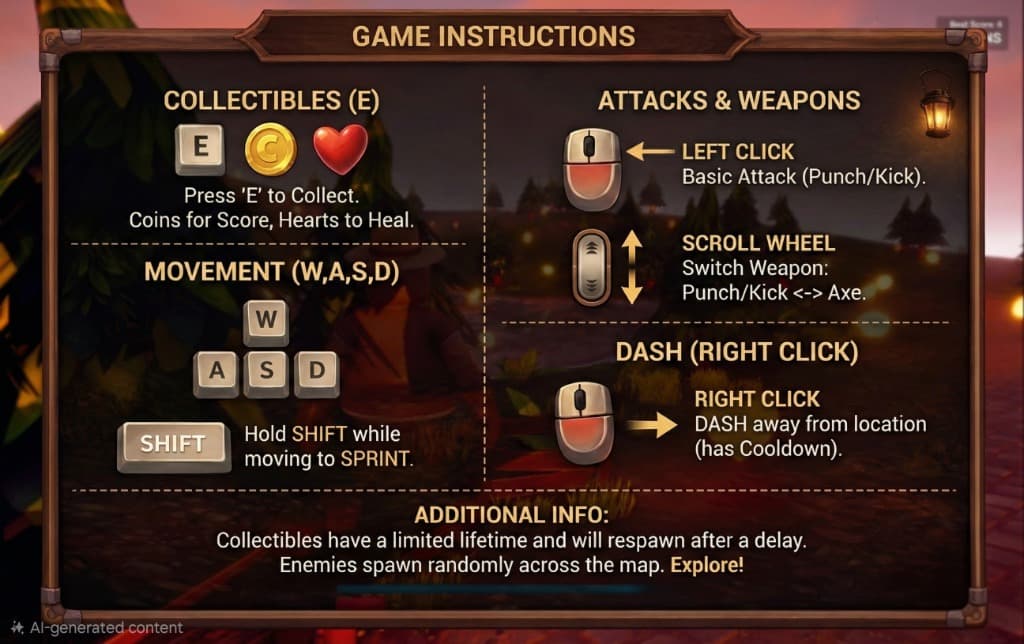
Prototype Demo
Live gameplay demonstration of the AURA adaptive system running in Unreal Engine 5, showing real-time procedural environment changes driven by player behavioural telemetry.
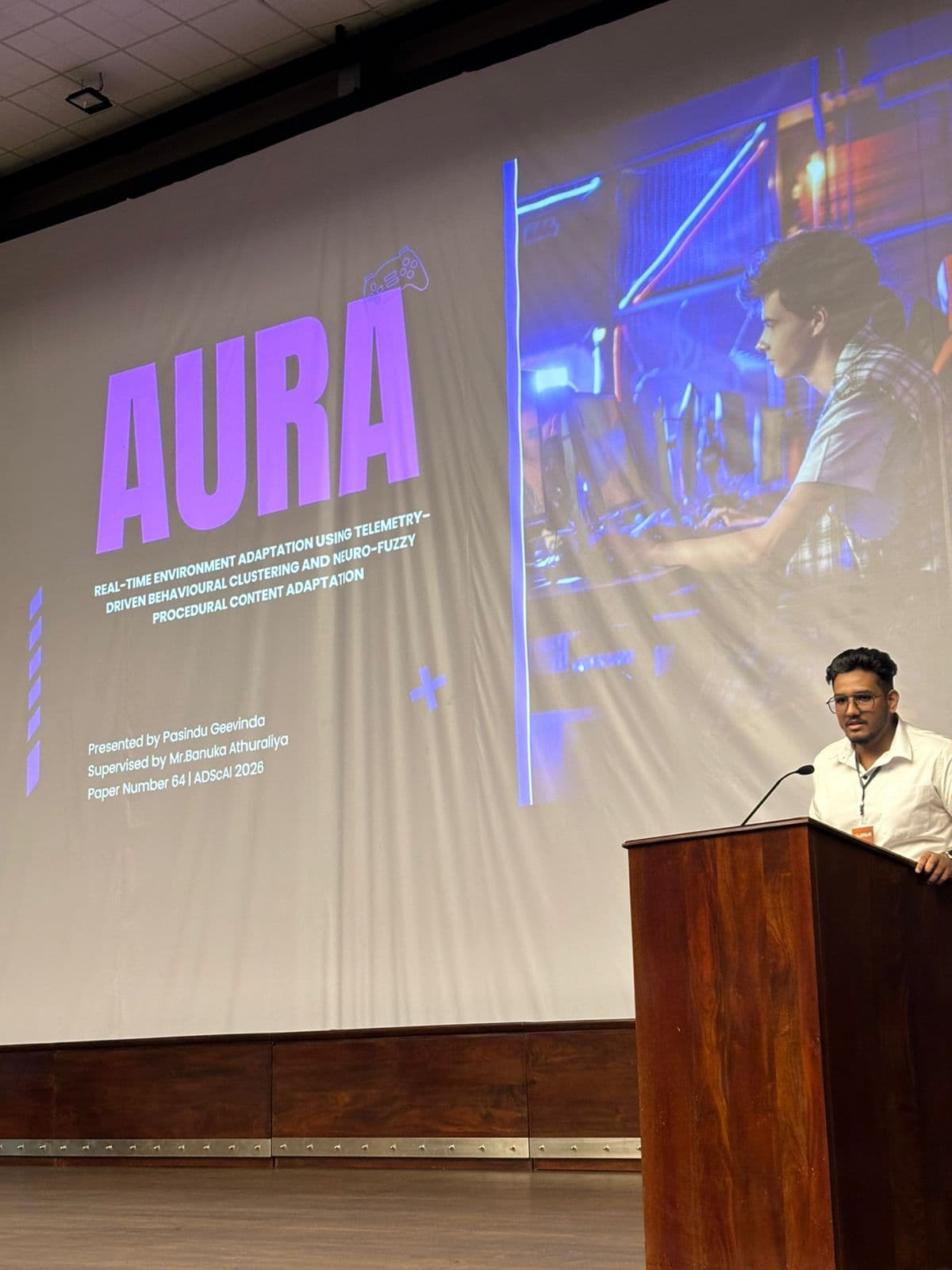
Research Presentation
Full academic presentation of the AURA framework covering the research problem, three-phase architecture, experimental results, and evaluation findings.
Raw Gameplay B-Roll (Muted)
Uncut gameplay sequence starting at 8:15, demonstrating real-time procedural and environmental adaptation.
Next.js dashboard · Deployed on Vercel
A publicly accessible dashboard exposing the full AURA inference pipeline — real-time behavioural membership weights (Combat / Collection / Exploration), adaptation multiplier time-series, and per-window session logs with validation indicators.
Academic Output
ADScAI 2026 · University of Moratuwa, Sri Lanka
K. W. J. Pasindu Geevinda, Banuka Athuraliya
Top 7 of 200+ Submissions
Selected among the best seven from over 200 submissions to ADScAI 2026 at University of Moratuwa.
Abstract
Dynamic Difficulty Adjustment (DDA) systems attempt to keep players engaged by varying the difficulty of the game in response to observed behaviour. Most current methods initiate adaptation immediately, resulting in cold-start bias, erratic early behaviour, and reduced interpretability. To overcome these limitations while maintaining player agency and behavioural validity, this paper presents a calibration-first, telemetry-driven adaptive game framework. Before any intervention, the system creates a statistically neutral behavioural reference by clearly separating the initial calibration from real-time adaptation. Soft membership across combat, exploration, and collection archetypes is used to model player behaviour while capturing behavioural fluidity without strict categorisation. An explainable ANFIS-inspired neuro-fuzzy reasoning formulation processes these representations with temporal deltas to generate bounded, forward-looking difficulty adjustments. Stable adaptation is ensured and oscillatory feedback is avoided through temporal smoothing and safety constraints. Empirical evaluation confirms the MLP surrogate approximates ANFIS-inspired teacher targets with 92.6% explained variance (R² = 0.9264), and that removing temporal behavioural signals collapses this fidelity by 38 percentage points, providing a principled foundation for reliable real-time adaptive gameplay.
Key Contributions
Calibration-First Methodology
Framework that explicitly separates baseline calibration from real-time adaptation to eliminate cold-start bias and feedback contamination.
Soft Behavioural Modelling
Soft clustering captures behavioural fluidity without forcing players into strict, rigid categorizations.
Explainable Neuro-Fuzzy Control
Forward-looking neuro-fuzzy reasoning layer (approximated by a runtime MLP) ensures stable, interpretable, and trustworthy adaptation.
Constrained Control for Player Agency
Bounded multipliers and temporal smoothing avoid oscillatory feedback and preserve player agency throughout adaptation.

Oral presentation · ADScAI 2026
Open Data
Kaggle · Published Dataset
Design
Neutral baseline established from real player data before any adaptive logic activates; calibration artefacts are immutable and never retrained.
IDW-based fuzzy membership replaces hard cluster assignment, giving smooth, proportional archetype representations across all windows.
Window-to-window membership change vectors capture behavioural momentum rather than relying solely on instantaneous snapshots.
MLP surrogate approximates the full ANFIS reasoning surface at < 1ms, making real-time deployment feasible without running full fuzzy inference in the game loop.
The inference pipeline runs entirely outside the game engine via HTTP REST — portable to any engine that supports HTTP calls.
Multipliers affect only future procedurally generated content, preserving player agency and preventing retrospective world modification.
All multipliers clamped to [0.6, 1.4]; 90-second session-state persistence prevents cold-start spikes and abrupt environmental shifts.
Real-time Next.js dashboard shows membership weights, multiplier time-series, and per-window session logs with validation indicators.
Removing temporal delta inputs collapses surrogate fidelity 3.7× (MAE: 0.0127 → 0.0478), confirming that behavioural momentum — not just instantaneous archetype state — is essential for accurate multiplier prediction.
Validation
The system was evaluated by 9 industry practitioners spanning two panels — 5 Domain Experts and 4 Technical Experts — using structured Google Meet sessions, written responses, and thematic analysis of qualitative feedback.
Evaluation evidence is documented in Appendix L & E of the thesis.
Evaluation Criteria
Resources
Research Outputs
Thesis · IIT Sri Lanka / University of Westminster, 2026
AURA: Real-Time Environment Adaptation Using Neuro-Fuzzy Procedural Content Generation with Behavioural Clustering
Dataset DOI: 10.34740/KAGGLE/DSV/15614101
Read Full Thesis (PDF)